Our Story
A note from the founder.
There is a particular kind of silence that belongs to a forest that has been emptied. It is not the silence of peace. It is the silence of absence, the kind you hear in a house after everyone has left.
I heard it for the first time in 2021, lying in a hammock in a half-built wooden structure in the middle of the Peruvian Amazon, listening to the night. There were frogs. The occasional bird. A faint rustling in the canopy. But it was thin. None of the layered, symphonic intensity the Amazon is famous for: no howler monkeys, no macaws, no dawn chorus dense enough to wake you from a dead sleep. The canopy was there, and it was green. From a photograph you would have called it beautiful. Beneath it, the forest was mute. No large mammals. No armadillos. No sloths. No tracks along the shore of the lake.
I was lying in the middle of the Amazon rainforest, and it was quiet. That should have been impossible. And it was the beginning of everything.
Why I came
I should say who I am, because it matters for this story. I am not a biologist. I am not an activist. My life has been institutions and governance, the architecture of how systems work or fail to work. In Ukraine I built a company and made the Forbes list before I was thirty; then I went into government, as deputy head of the region that holds our Carpathian forests, and later as an adviser to the President on how the country governs its woods. I ran the campaigns, led the protests, defended those forests every way I knew. And all of it taught me one thing I have never unlearned: the real answer is never found in high offices. It is found at the source.
So I went to the source. I spent a month on a riverboat going up the Amazon from Manaus toward the three-border country where Peru, Colombia and Brazil meet, sleeping in hammocks strung between trees, washing in a river we knew was full of caimans. Two weeks upriver, in a village I had never heard of, the head of a small community sat with me by a single candle and unfolded a paper he kept hidden like a relic: a notarised title to a quarter of a million hectares of rainforest. Then he opened the village accounts, kept by hand in a school notebook. Three hundred people, living on a hundred dollars a month, guarding that forest with two rifles, both of them illegal, against men who arrive with fire. And they guarded it completely, for nothing.
I sat in that candlelight and felt something I had not felt since I left politics. Not pity. Fury. The best guardians this forest has, and the world is built so that keeping it alive holds them in poverty, while burning it down would have made them rich.
I did not come to the Amazon to admire it. I came to answer one question in practice, with my hands in the soil: is there a way of organising people and forest so that protecting it becomes an advantage rather than a sacrifice? The best way I could find to answer it was to live in it, to become a landowner, and to learn the rules of a system that has run for millions of years without us.
The frontier
I bought land among the chacras, the small family plots beyond the last houses of Santa Clara de Ojeal, about forty minutes from Iquitos. Ecologists call places like this a frontier: the zone where settlement presses against intact forest and neither side has yet won. It sounds abstract until you stand in one.
The arithmetic of a frontier is devastating. Each family here clears roughly five hectares a year by slash and burn: the trees are felled, the brush dries, the match is struck, the ash feeds two or three seasons of crops, and then the family moves deeper and burns again. Santa Clara has about a hundred and fifty families. That is nearly a thousand hectares of jungle a year, lost to a single settlement of four hundred people, not to a corporation, not to a bulldozer, but to small fires set by people who were given land and no other model for using it. Multiply that by the thousands of settlements along the rivers of the Peruvian Amazon and you have how the forest actually dies: not from the centre, but from the edges, hectare by hectare, family by family, fire by fire. Which means that if you want to learn how to save it, you do not start in the deep interior. You start here. At the edge.
Building something in the middle of it
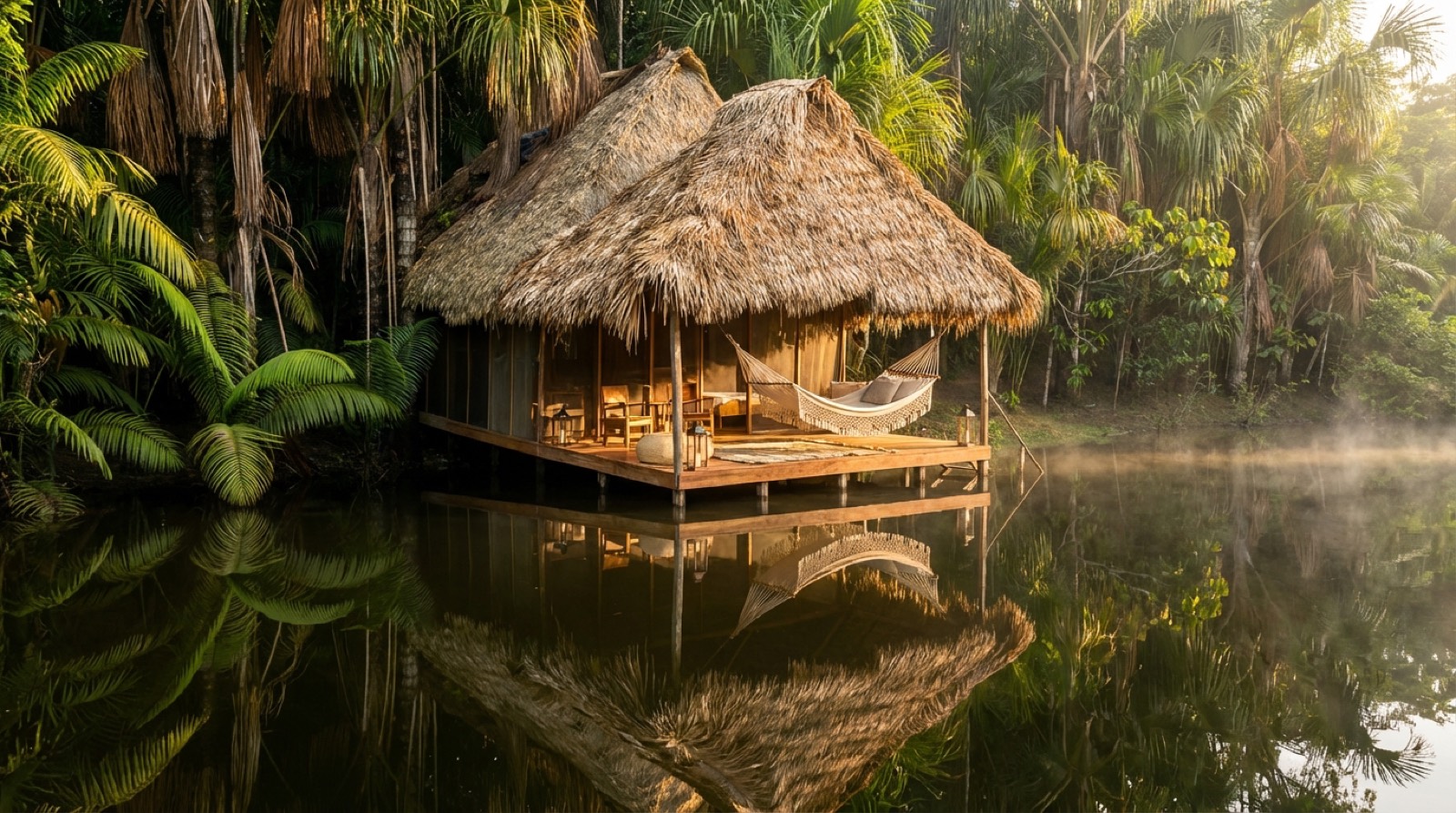
For three years I lived in the jungle, side by side with workers from Santa Clara, building what became AWAKEN Sanctuary: timber and palm, materials bought from the families around us, villas set into the forest rather than cut out of it, a lake with a platform in the middle of it, a restaurant, a yoga hall, our own water, our own power, Starlink reaching down through the canopy. I want to be precise about what it is, because the words matter. It is not a hotel. It is a place where people enter the jungle not as tourists but as students of a system so interconnected and so quietly overwhelming that it rearranges something inside you. The Amazon does that if you let it. It does not lecture. It demonstrates.
The cost of believing was my body. I had dengue three times, and after one of them I spent the better part of a year too weak to rise. Banknotes turn to pulp in your hands in that wet; clothes grow mould on the hanger; in a long drought you count the days until the water runs out. I had spent my whole life in cities. Out there I belonged, entirely and without appeal, to the weather and the water. And, to my surprise, I was glad of it.
But before any of the philosophy could matter, I had to do something much simpler. I stopped the logging on our land. I stopped the hunting. I let the forest be.
The silent call
What happened next I watched from my own window, and it is the most extraordinary thing I have ever seen.
The forest did not come back at random. It came back in order, as if following a blueprint no one had written. First the soil fungi, rebuilding the underground networks that let trees share food and warnings. Then the pioneer plants thickening the understory, which brought the insects, which brought the birds. My favourite hour became five o'clock in the afternoon, when I would walk out to the platform in the middle of the lake. In the early months a few birds would come. Within a year whole families were arriving between five and six every evening, great flocks descending onto the trees around the water, and I would sit and feel the forest slowly turning up its volume.
Then the mammals. Caimans in the lake. Iguanas on the banks. Armadillos digging near the tree house. A family of majas, large spotted rodents heavily hunted in this region, settled beside my own villa. Sloths on a terrace. A troop of monkeys that arrived at ten every Sunday morning in the trees beside my room and squabbled with the birds like a small, noisy soap opera. We began naming the villas after the animals that had claimed them. One day we found a baby sloth on the path, fallen, mother gone; we fed it from a spoon and named it Kusi, which means joy in Quechua. It could not survive without its mother and we had to hand it to a refuge, but even that small heartbreak was evidence: the sloths were here, and they felt safe enough to raise their young. Anteaters returned. Tortoises. And then ocelots, the small elusive cats whose presence tells a biologist that a recovering forest has rebuilt its prey base.
And then, one June, lying in my bed at night, I heard it. A deep, hoarse roar in short sequences, the kind of sound you feel in your chest before your ears have finished registering it. Two or three kilometres away, but in the wet air of the jungle it sounded as though the animal stood just beyond the wall. Every night it came back. The people of Santa Clara confirmed it: they had seen the jaguar.
A jaguar does not return to a landscape casually. It comes only when the prey base has recovered and the cover is sufficient, when the forest has rebuilt itself to the point where it can carry its most demanding resident. Every returning bird and armadillo and sloth had been a note in a melody rebuilding itself. The jaguar was the full chord. It was the forest saying, in the clearest language it has: I am alive again. I lay in the dark and cried from the joy of it.
What the edge taught me
The frontier does not give up its habits because one patch of it heals. As the animals returned, so did the hunters, and I learned that building a refuge is only half the problem. The other half is the landscape around it, where wildlife is still a free resource, a supermarket with no walls. One afternoon the phone rang with the news that a young cat had been killed near the sanctuary, skinned, its pelt offered for two hundred and fifty dollars. For nights afterward its mother circled the territory in the dark and cried, and if you have ever heard an animal grieve through the thin air of a jungle night you know it is not something you interpret. It enters you below language, and it stays.
I understood then what the whole project is really about. The people who live beside this forest are not its enemies; they are the descendants of communities that once held the jaguar sacred. They can be the ones who dismantle the forest or the ones who keep it, and the difference is whether anyone has given them a reason. That is why the Sanctuary was built the way it was: forty-five permanent jobs for the four communities around us, materials bought from local families, a cooperation agreement in place since 2020, a volunteer centre and women's enterprise programmes in the village, Shipibo healers welcomed on the land. The forest already knows how to come back. The work is building the human system that lets it.
The storms, and the next chapter
In February 2024 a thunderstorm destroyed our electrical system. Through that summer the river fell lower than anyone could remember. Then, between September and November, winds no one here had ever seen tore the roofs off twelve villas, flattened the yoga hall and knocked out two of our three water pumps. By then we had hosted ninety-six guests from fifteen countries in a single season, a forty-person yoga retreat and a twenty-person dance retreat among them, and the forest around us was fuller every month. We closed the gates in November.
I have carried this place for five years, in my body and my accounts, and I know exactly what it is: a built sanctuary on titled land at the precise edge where the Amazon is being lost and where, as we proved, it can be brought back. I will restore what the storms took before I hand over the keys. What the next owner receives is a property that already works, a community that already knows us, and a forest that has already answered the question I came here to ask. Whether I stay on as a partner inside the team or hand it over entirely, the Sanctuary needs someone who can carry it into its next chapter with more than one pair of hands.
The jaguar is still out there. At night, when the Sanctuary goes dark and the jungle fills with everything that lives in it, that deep roar still comes through the trees. It has not left.
The question is who will be there to listen.
Olga Sytnyk, founder of AWAKEN Sanctuary. Guest, community and wildlife accounts are from the property's own records; the jaguar's permanent return remains the horizon, not a present claim.